Mongolia: The Nomads
Sheesh, I am back home after one of the busiest and most exhausting trips I have ever been on. It was over 18,000 miles of flying across 40 plus hours in the air, followed by more than 50 hours of driving on rural dirt roads. That was roughly 100 hours of pure travel time squeezed into just two weeks. Insane.
Outside of Naadam, the thing that stood out to me most was the people. Specifically, the nomads.
Living in yurts on vast land they do not own, these families look after massive herds of yak, reindeer, horses, cows, goats, and sheep, often numbering over a thousand animals. Most families relocate every six months, packing up their entire lives to move 20 or 30 miles across the steppe. They live in large, multi-generational families with no electricity or running water, but with plenty of fermented mare's milk. Their way of life was endlessly intriguing to me, and I was so grateful we had the opportunity to stay with a few of these families along the way.
The first family we stayed with consisted of a grandmother and grandfather, two of their adult children, and a whole gaggle of grandchildren.

The grandfather stood tall and strong, but his presence extended well beyond his already impressive physical stature. After navigating the countryside to find their two yurts sitting alone in the vast landscape, he invited us inside for the traditional greeting ceremony that accompanies every nomadic visit.
We sat down with the grandfather as he pulled out a small glass vial that looked ridiculously tiny in his massive hands. He opened the top, scooped out a bit of brown powder, and pressed it onto the web of his hand. Raising it to his nose, he inhaled the powder deeply. Ground snuff tobacco.
He passed the vial to Tessa, who followed suit and passed it back to him. Then he passed it to Daniel, who did the same and returned it. In Mongolian custom, you always accept and return items using your right hand. Finally, the grandfather passed the vial to me. I took a solid snort as if I had done it a hundred times before. Feeling the tobacco tingle all the way up through my nose to the back of my eyes, it instantly blew away whatever jetlag I had left.
Next, the grandmother brought out fermented horse milk and a bowl of dried curd. The milk was incredibly sour with a punch.
As we went through the traditional customs, we asked the family about their daily lives. I asked what their biggest challenge was living out here.
The grandfather replied plainly: "Wolves."
"They come every night," he continued through our guide. "We lost two animals from the herd just last night."
Being a hunter myself, I sat up, immediately intrigued by the prospect of wolves nearby. Daniel chimed in to tell him I was a hunter, and I asked how I could help.
All of this was being filtered through Tessa, our guide and translator, who was looking increasingly uncomfortable. He clearly did not want his foreign tourists running around in the dark looking for wolves on his watch.
The grandfather looked at me. "Can you shoot well?"
"Yes, of course," I said.
"Can you shoot a moving target? Because they do not stop moving."
"Yes, absolutely."
Tessa was so visibly uneasy at this point that he stopped translating altogether. I had to nudge him to ask the grandfather again how I could help.
The grandfather just looked at me and said, "When you hear the dogs, that means the wolves are here."

We went outside to play with the kids while the family prepped our yurt. When they finally showed us inside to unpack, I noticed a rifle sitting in the corner right next to my bed. Now I knew a new kind of night was unfolding.
We spent the rest of the evening on horseback, herding the thousand animals closer to the yurts so they would not wander off and could be protected during the night. The horses were much smaller than what we’re used to, these specific horses were stubborn but as race horses they knew one thing, speed. We rode the horses hard and fast, getting a real taste of life as a local.
Later that night, we went to sleep. It did not take long for the dogs to start barking frantically.
I stepped outside the yurt, and the freezing night air washed over me. I looked up into a sky packed with stars, with the Milky Way pouring overhead. I could hear the dogs barking as they circled the herd, and I saw a flashlight beam sweeping across the landscape on the far side of the pasture. But that night, the wolves stayed away, or perhaps hidden.
The next day, as we were driving through the mountains, I spotted something way up on the ridge. I urged Tessa to pull over. He grabbed his binoculars, dialed them in, and gasped. It was a wolf.
Tessa was completely shocked. He had previously told me you only ever see a wolf's eyes reflected at night. Turning to me, he said, "Only someone with a windhorse equal to that of a wolf can see one, and only someone with a windhorse greater than a wolf can take one. It will be interesting to see how this trip goes."Windhorse Tessa previously described as the inner spiritual energy, luck, and soul strength that every person carries. To Mongols, your windhorse determines how you navigate life's obstacles. If your windhorse is strong, good fortune and protection follow you; if it is weak, bad luck takes over. Comparing my spirit energy to that of a wild wolf was about the highest compliment a Mongol could give.
Throughout our journey, we stayed with several nomadic and semi-nomadic families, as well as a small guest camp where I met Bor.

Bor might be one of the coolest human beings I have ever met. The locals claimed he was around 90 years old. He owned a handful of yurts that served as a middle ground between a true nomadic homestead and a modest tourist camp.
When we arrived, we gathered inside Bor’s yurt for the usual welcome ceremony. He brought out his snuff tobacco, and by now, I eagerly took a big hit and handed it back. To my surprise, he handed it right back to me for a second round. Tessa translated with a smile: "He says you did that so well you deserve another."
I happily obliged.
Bor informed us that we would be staying in his main yurt, while he would sleep in the back of his wooden wagon. Later that evening, as more people arrived, the wagon filled up too. Without a second thought, Bor simply wrapped himself up and slept right on the dirt outside.
Now having traveled back south, this camp sat on the edge of the Gobi Desert. While Daniel and some other travelers went off on a camel ride, I took the opportunity to kick back on a picnic table with Bor and a few of the drivers. We drank beers, crushed a bottle of vodka, and I even smoked a few cigarettes with Bor, which is something I almost never do.
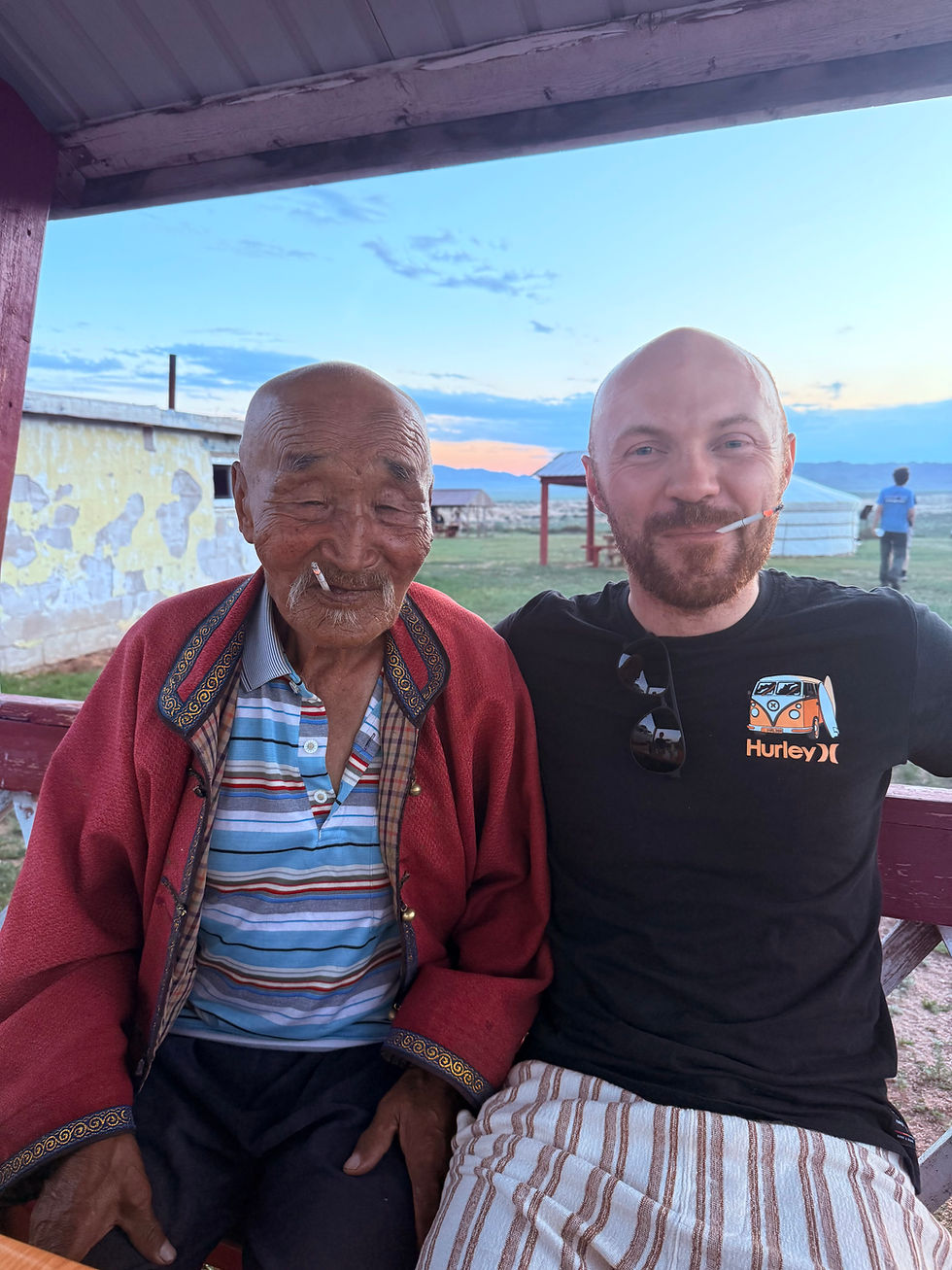
We sat there talking about life, love, and relationships. Bor insisted that I needed to hurry up, get married, and have kids. I mentioned that I had met with a shaman just a few days prior who told me it would be another two years before I met the right person. Bor just shrugged it off, saying he thought that shaman got it wrong.
Then he added a piece of advice: "You should be like me. I have been married for 67 years."
I asked him how old he was when he got married. "34," he replied.
I smiled. That was just two years older than I am right now.
I am well aware that his claimed age of 90, his age at marriage, and the duration of his marriage do not quite line up mathematically. I do not know the exact truth, but it honestly would not surprise me if he was actually over 100. Whenever locals talked about his age, it was never a set number; it was always "around 90" or "over 90," as if no one knew for sure.
Bor quickly became one of my absolute favorite people on the trip. We clicked instantly, and the drivers kept joking that we were twins, which I assume was a compliment to our personalities.
At one point, I asked what his name meant in Mongolian. He said it meant "Brown," and then chuckled as he gestured to his arm. “It was as if my parents knew,” he joked. His parents had apparently stated the obvious.
These were just a few of my favorite moments with the locals. Their generosity, warmth, and hospitality were felt everywhere we went, making them one of my absolute favorite groups of people I have ever had the privilege to meet.
